For sale
Paintings for sale
Original paintings, drawings and gouaches by Henk van Dam currently available: landscapes of De Woude and the Alkmaardermeer in North Holland, the Circulades and the Clivia, to impressions from the French Hérault. Each work is shown here with photo, size and price. Click on a work to enlarge it, or ask about it via the button — you will receive a reply by email, with no obligation.
Pick-up in De Woude is always possible; shipping can be arranged, with costs discussed individually. Because each work is unique and original, returns are not possible after purchase.
No. 1
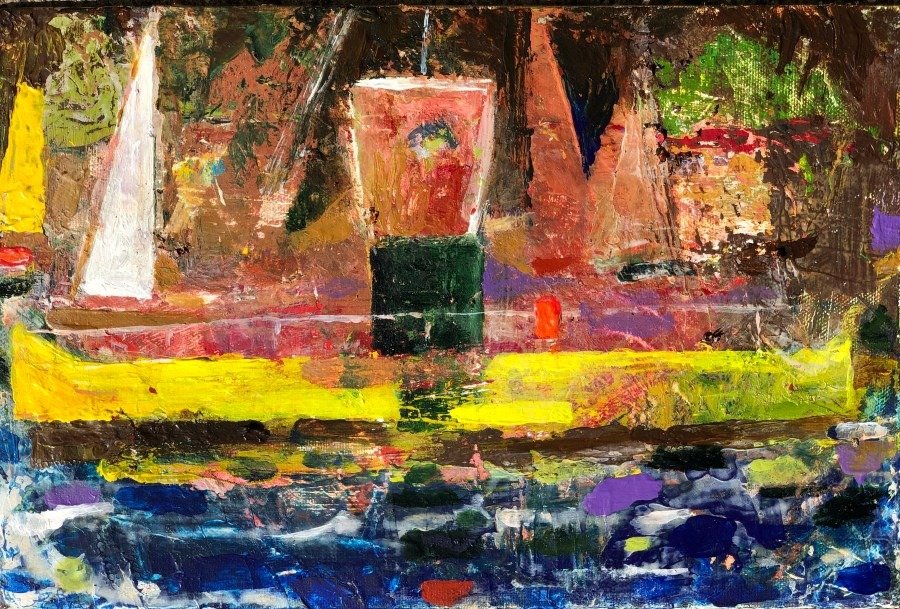
Markervaart – the ferry
The ferry across the Markervaart, the familiar crossing between shore and island, captured in colour and rhythm. On this small canvas the ferry is reduced to a dense weave of planes: a bright yellow deck, a dark green block for the wheelhouse, pink and ochre strokes catching the light on the water. The paint is applied thickly with the palette knife, with traces of earlier layers showing through the top layer. Toward the bottom of the canvas the water itself is painted darker and rougher, blue and purple rubbing against each other — the daily crossing, not as a story but as a sensation of colour and movement.
€ 275
Ask about this work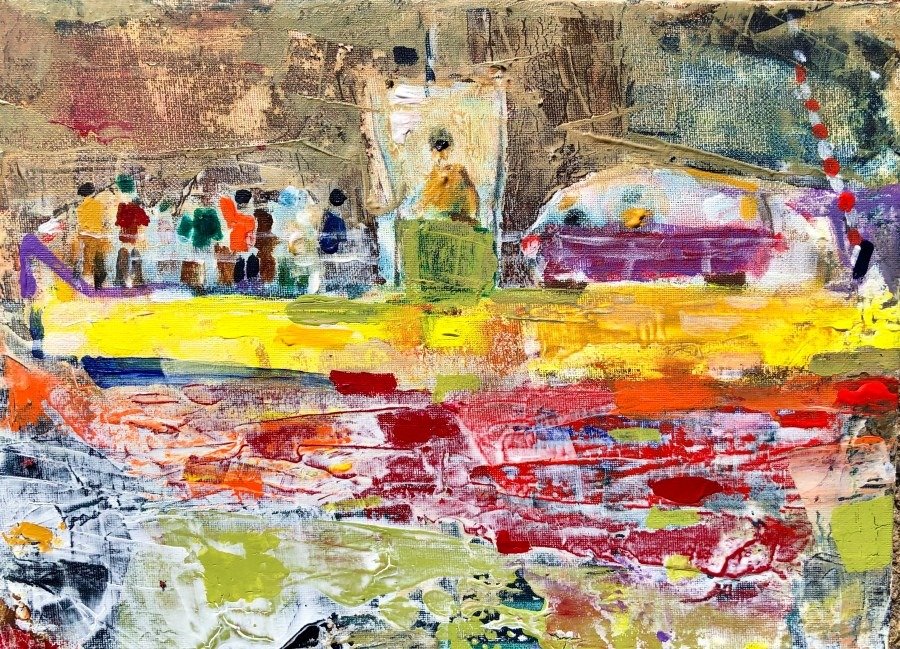
No. 2
Markervaart – the crossing
The ferry in motion on the water — a moment Henk van Dam has revisited countless times. On the ferry a row of small figures waits, loosely set down in dabs of paint, while the ferry itself fades into a pale, purplish-outlined shape. Below the horizon the canvas opens into a yellow band and a wild, red-orange reflection on the water, where the colours of the sky and the ferry run into one another. It is one of the many times Henk van Dam paints this crossing — each time with a slightly different light, a different temperature of colour.
€ 295
Ask about this work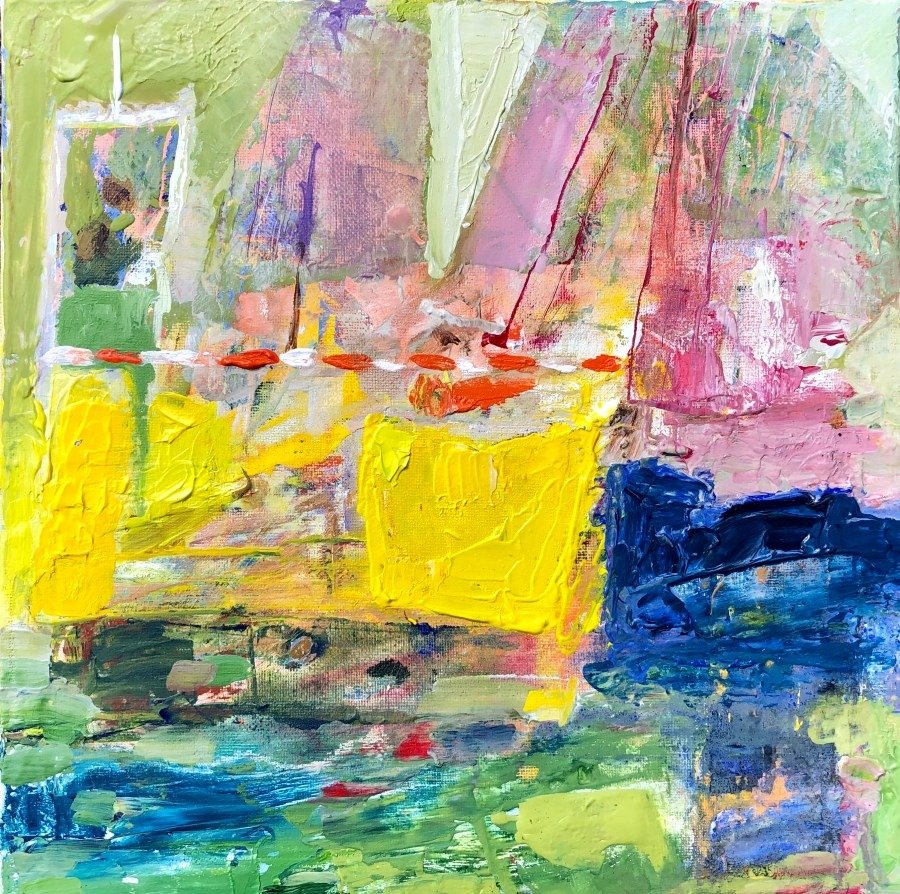
No. 3
Untitled — Markervaart
Water, shore and ferry: a smaller study of the familiar crossing near De Woude. The canvas is built from solid blocks of yellow and blue, cut through by a row of small orange dots that seem to run across the water like a line of beacons. At upper left, almost hidden, a small window is painted with a faint figure inside — a glimpse of someone on board. The composition stays close to the flat plane: no depth is sought, only a play of colour fields that together evoke the sensation of a crossing.
€ 275
Ask about this work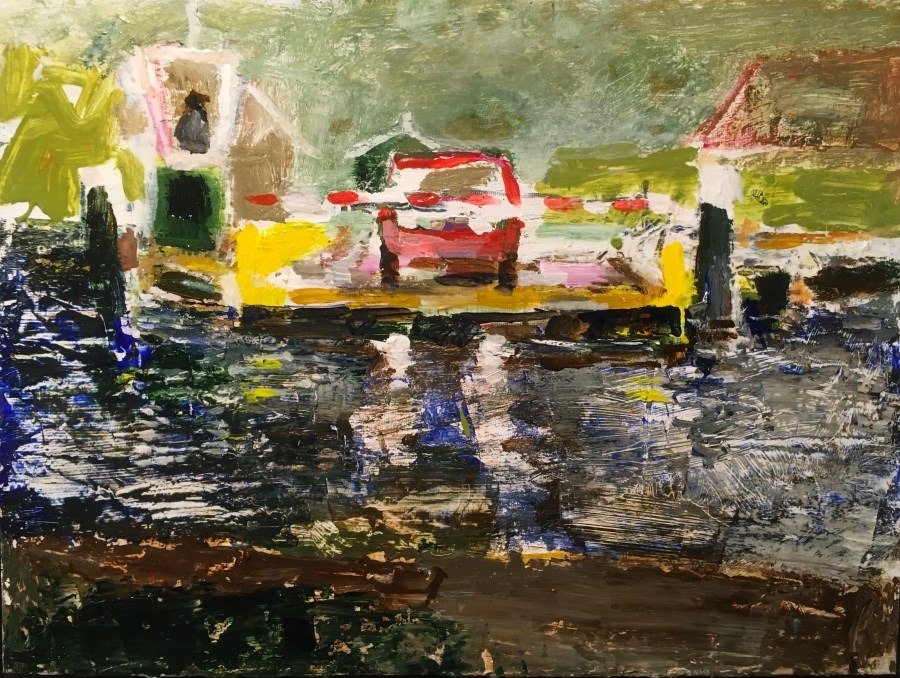
No. 4
Pontveer
The ferry crossing that connects De Woude to the mainland, rendered in muted colours. In the wheelhouse, the ferryman is visible. A car is reduced to a compact red plane, mirrored in the dark water below the quay. Green roofs on either side close off the composition. It is a quiet, earth-toned counterweight to the brighter, more abstract Markervaart canvases — the same place, painted in a stiller key.
€ 275
Ask about this work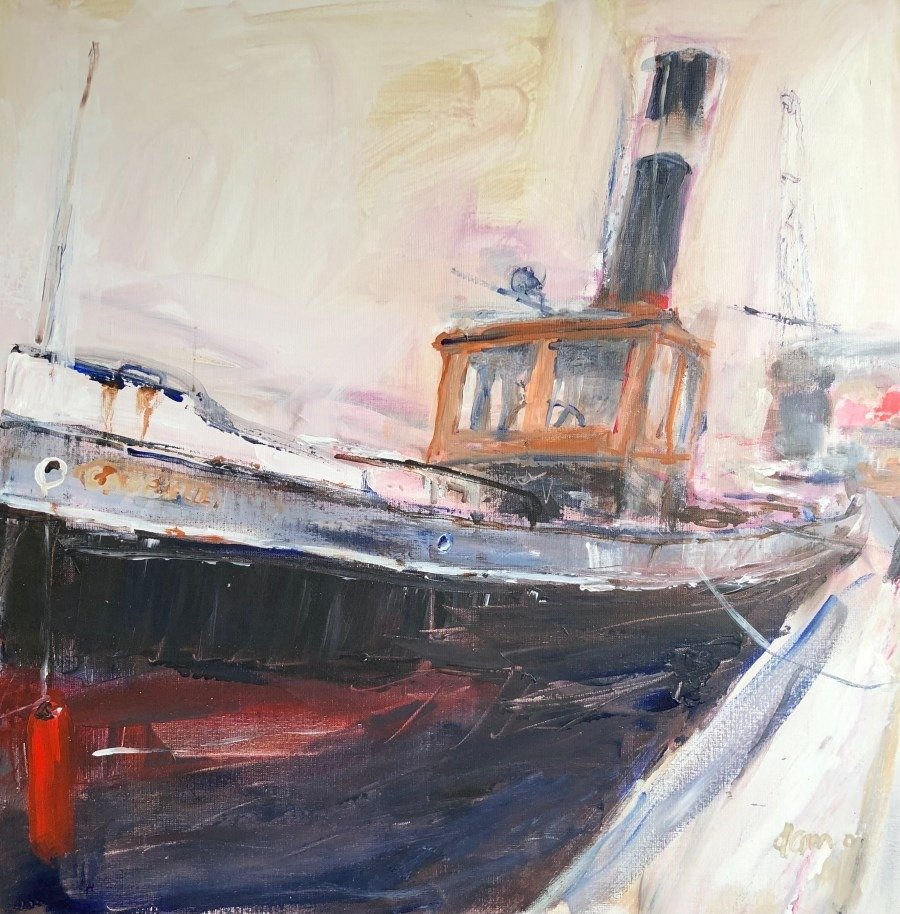
No. 5
De Gabrielle van Jaap Koeman
A portrait of the Gabrielle, Jaap Koeman's steamboat, at a larger scale and with more attention to detail than the other Markervaart canvases. The name is still just legible on the hull, the wheelhouse built up in warm ochre tones against a hazy, pink-tinted sky. The dark water beneath the bow takes up nearly half the canvas, with traces of red and blue showing through the black. Where the other ferry studies are quick and abstract, the Gabrielle is given the time and the space of a true portrait.
€ 750
Ask about this work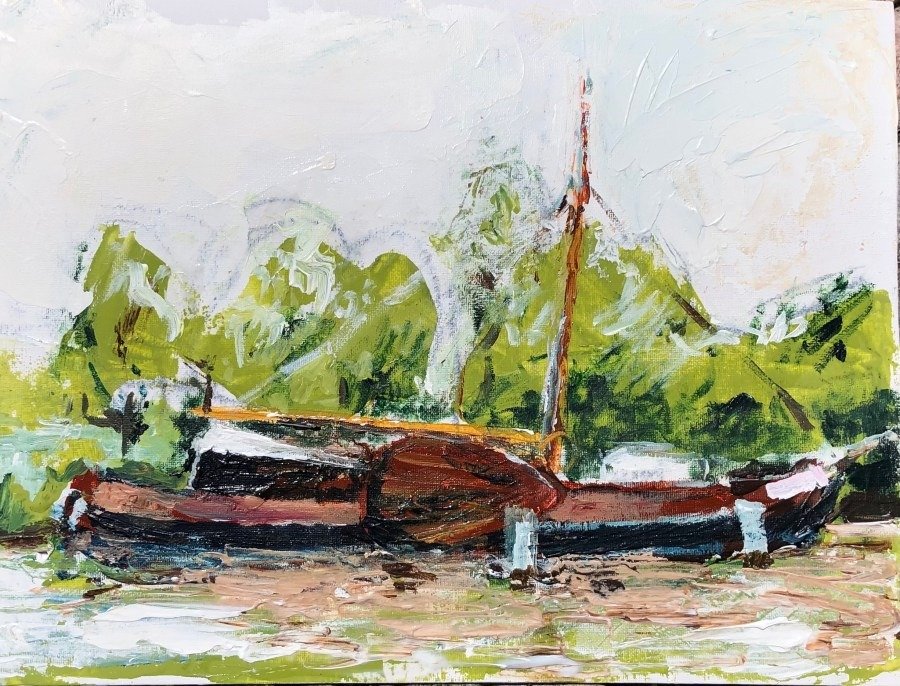
No. 6
The Gratitude
A painting about connection to a place — gratitude for life on and around the water. An old iron boat lies at the shore, its hull dark red and black amid the mudflats, with a single mast standing straight up against a hazy, pale sky. Behind the boat stands a dense cluster of trees in a bright, almost fluorescent green — one of the few places where Henk van Dam lets that colour stand so unmixed. It is a quiet, almost motionless image: no people, no movement, only the boat and its place by the water.
€ 275
Ask about this work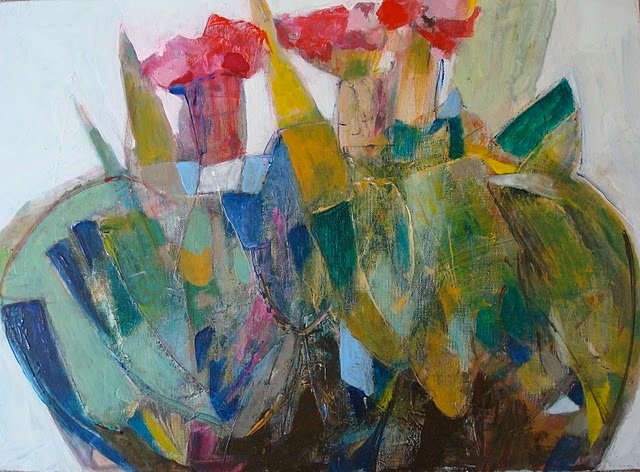
No. 7
Untitled — Clivia (50×60cm)
A Clivia that has been in the family for more than seventy years, captured in form and colour. The red flower clusters stand as a group of bright marks above broad, angularly painted leaves in green and yellow-ochre that fill the entire lower half of the canvas. The pot itself is reduced to a simple round plane in petrol blue. There is no attempt at botanical precision: leaf and flower are flattened into planes that rub against each other, held together by thin black lines.
€ 550
Ask about this work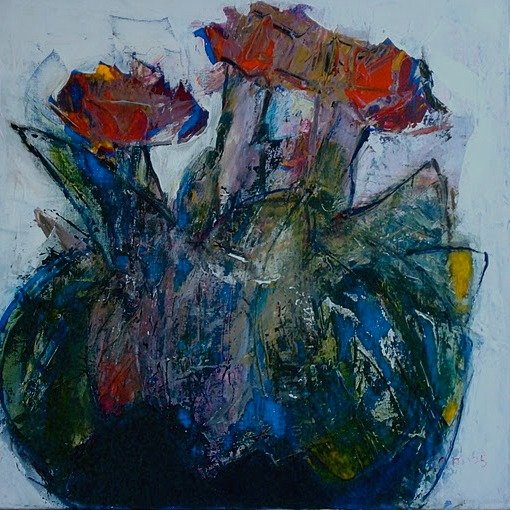
No. 8
Untitled — Clivia (50×50cm)
The same Clivia, seen again: leaf and flower reduced to plane and rhythm. Here the canvas is darker and denser than in the other versions — the leaves are deep green and navy blue, applied thickly with the palette knife, with the orange-red flowers as the only bright note at the top. Toward the bottom the plant almost disappears into the darkness of the pot. It is the most sombre, most restrained of the Clivia studies, in which the familiar plant becomes less a portrait than a mood.
€ 550
Ask about this work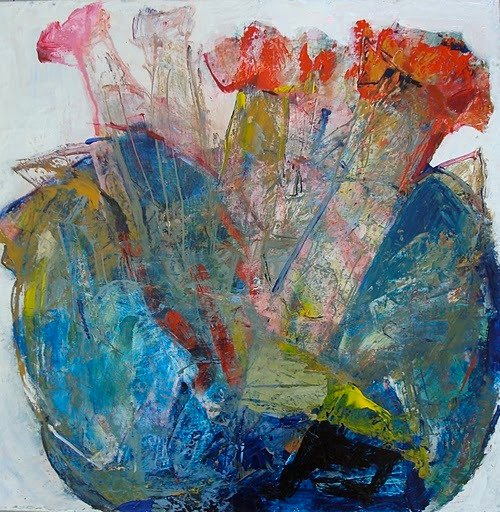
No. 9
Untitled — Clivia (50×50cm)
Another version of the Clivia — a different view each time of the same familiar subject. This time the ground is lighter: pale pink and sky blue between the leaves, with ochre and yellow accents letting the light in. The red flowers at the top are looser, almost sketch-like, with thin lines scratched out of the paint. Where the other Clivias are closed and dense, this canvas breathes more — a lighter, more open variation on the same fixed theme.
€ 550
Ask about this work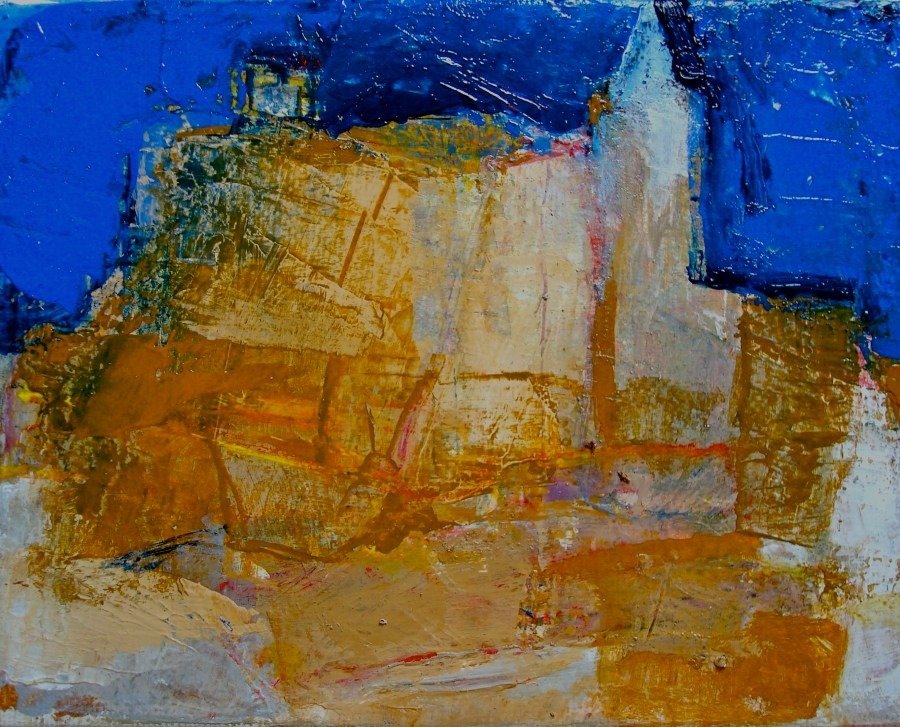
No. 10
Untitled — Circulades (14×18cm)
One of the circulades of the Languedoc: an old walled village reduced to stone, shadow and silence. The village walls stand in warm ochre and sand tones against a deep, unmixed blue sky — a contrast that recurs in almost every circulade canvas. A small window, with a touch of yellow and red, is the only sign of habitation in the otherwise closed façades. The paint is applied thick and dry, with scratches that make the stone feel almost tangible.
€ 295
Ask about this work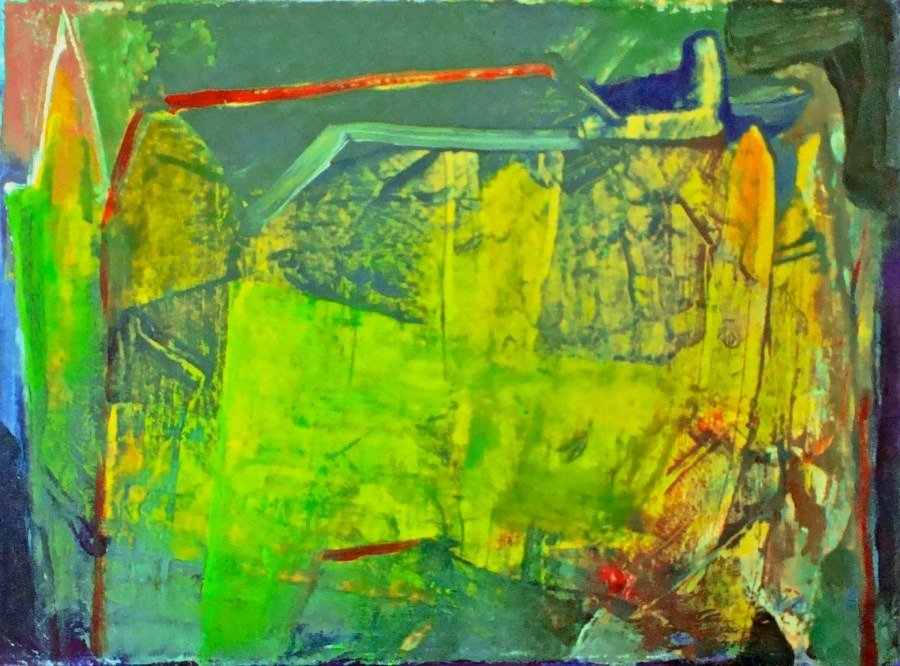
No. 11
Untitled — Circulades (18×24cm)
A circulade in the French Hérault, with the characteristic light of the Languedoc. In this canvas a bright, almost acidic yellow-green dominates, cut through by a thin red line running through the composition like a path or a wall's edge. The shape of the village is only just recognisable — here the circulade is above all a pretext for colour, light and the texture of the paint itself. At upper right a small blue accent appears, like a glimpse of sky between the rooftops.
€ 325
Ask about this work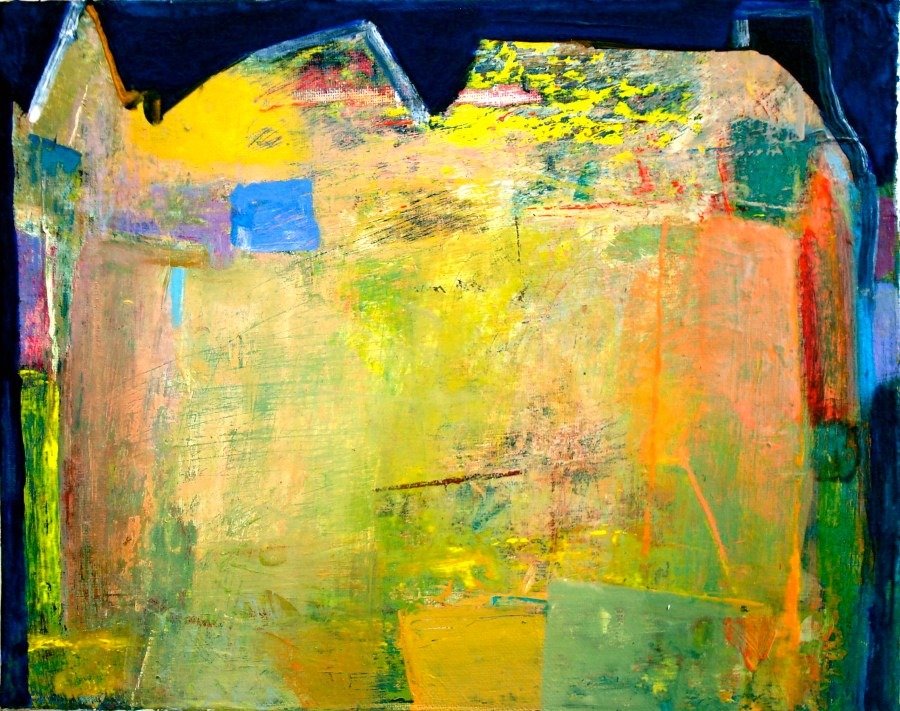
No. 12
Untitled — Circulades (24×30cm)
A larger canvas from the circulades series, with more room for the composition of the village. The pointed roof lines of the houses stand out against a dark navy-blue sky, while the façades themselves are built up from warm yellow, orange and ochre planes. The larger format gives the composition more air: the shapes of the village stay more recognisable than in the smaller studies, without losing the density of the paint.
€ 325
Ask about this work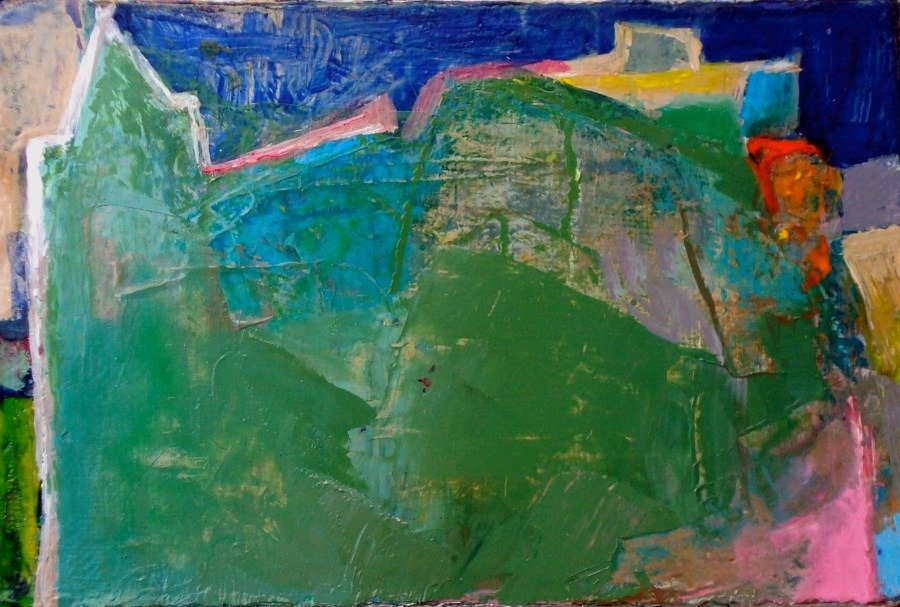
No. 13
Untitled — Circulades (12×18cm)
A small study of a circulade — quickly seen, quietly built up. The village here is reduced almost entirely to an undulating green plane spreading across the whole canvas, with a narrow strip of pink and yellow roof just peeking out against a deep blue sky. A single orange mark on the right breaks open the otherwise cool palette. The rough, grainy paint texture shows how quickly this canvas came together — a sketch in paint, more than a fully worked composition.
€ 275
Ask about this work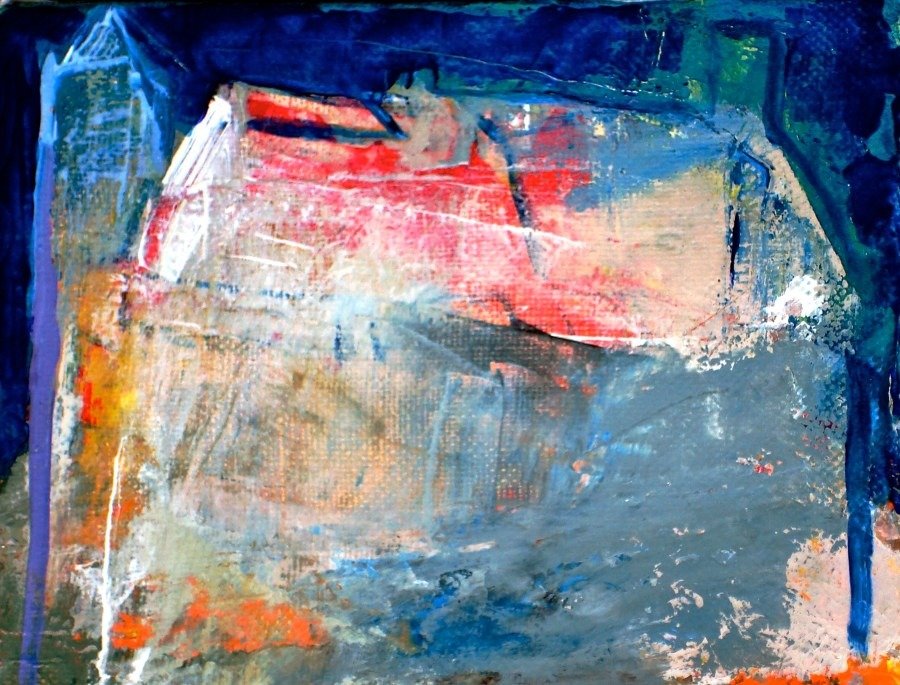
No. 14
Untitled — Circulades (12×18cm)
Another small circulade study from the same series, with a slightly different light. Where the other studies are cool and green, here a warm, almost burning red patch dominates — a roof or wall catching the fierce midday light of the Languedoc. Beneath it the rest of the village dissolves into a haze of grey and ochre, with thin streaks of orange running down along the lower edge. It is the most sketch-like of the small circulade studies, with much of the canvas still left open and unpainted.
€ 275
Ask about this work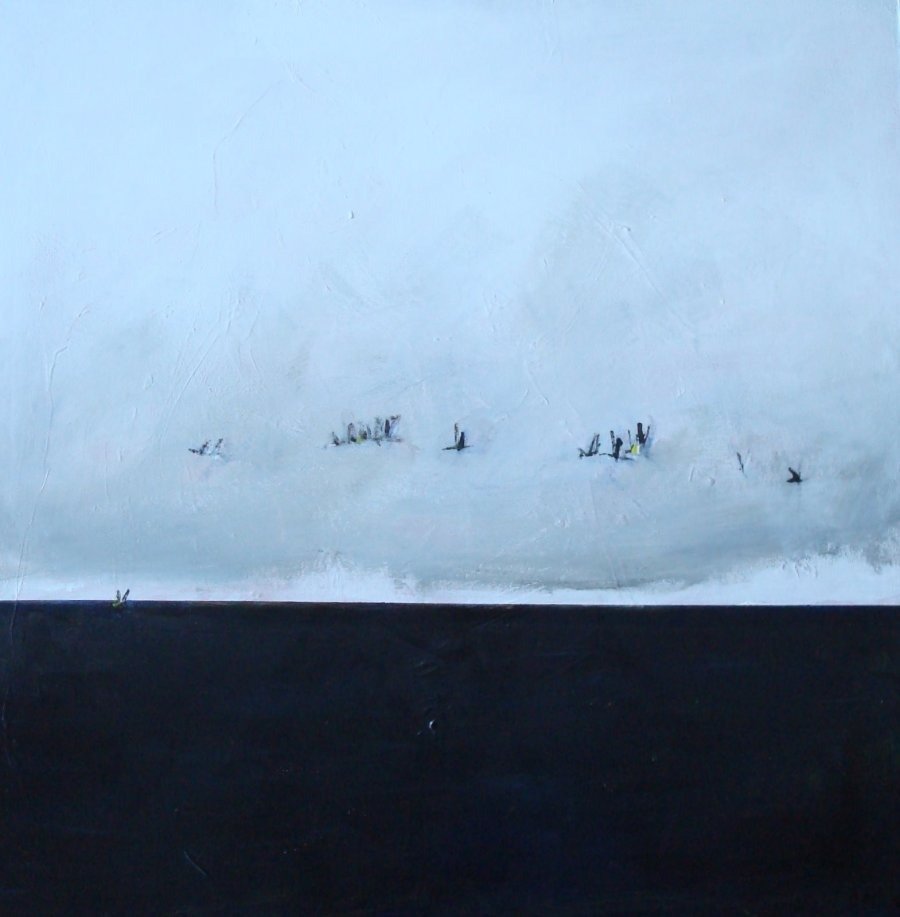
No. 15
Untitled — Island (100×100cm)
A large canvas of De Woude: the island, the water and the sky in a single composition. The format is large, but the composition is extremely sober: a broad, hazy pale sky above a flat, almost black waterline, with only a handful of small dark marks — birds, small boats, perhaps reeds — standing like loose notations on the horizon. There is barely any colour, barely any movement. It is one of the quietest canvases in Henk van Dam's work, in which the emptiness of the island itself becomes the subject.
€ 925
Ask about this work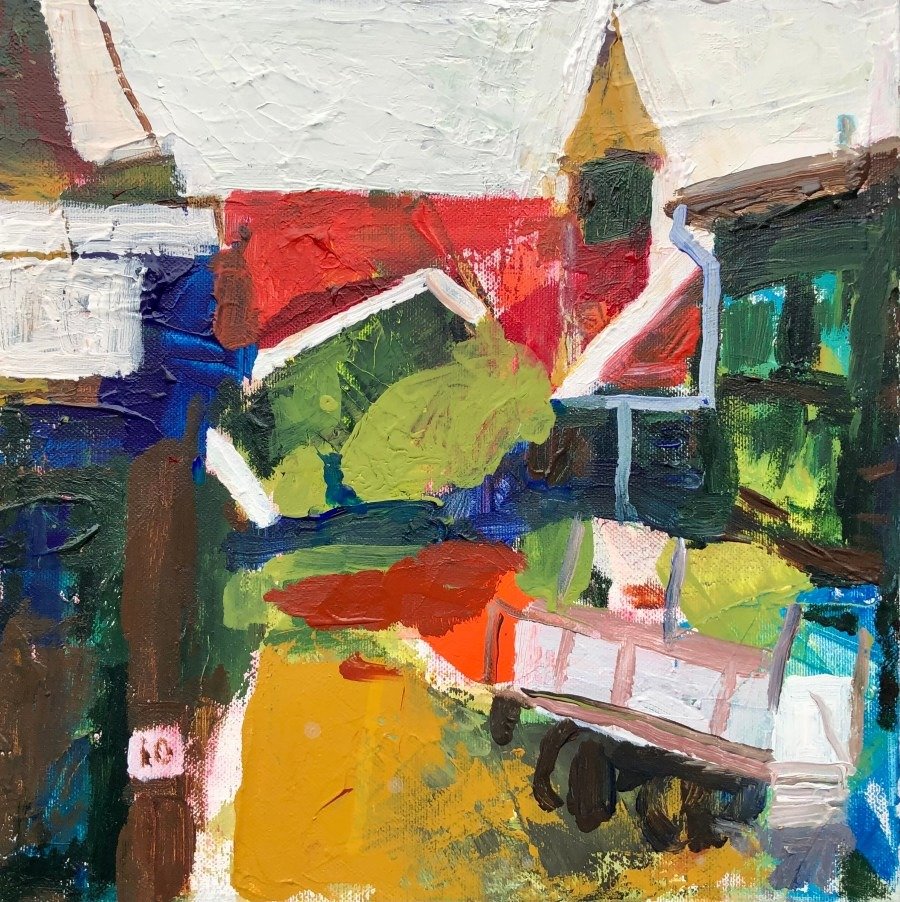
No. 16
Woude 10
Woude 10, one of the numbered studies of the island where Henk van Dam lives. A red roof and a small yellow tower rise above a dense cluster of buildings and trees, with a pale wooden cart or jetty. The colours are fuller and warmer than in much of the other island work — ochre yellow, deep red, a touch of orange. The canvas belongs to a series of numbered studies in which Henk van Dam captures a different corner of De Woude each time.
€ 225
Ask about this work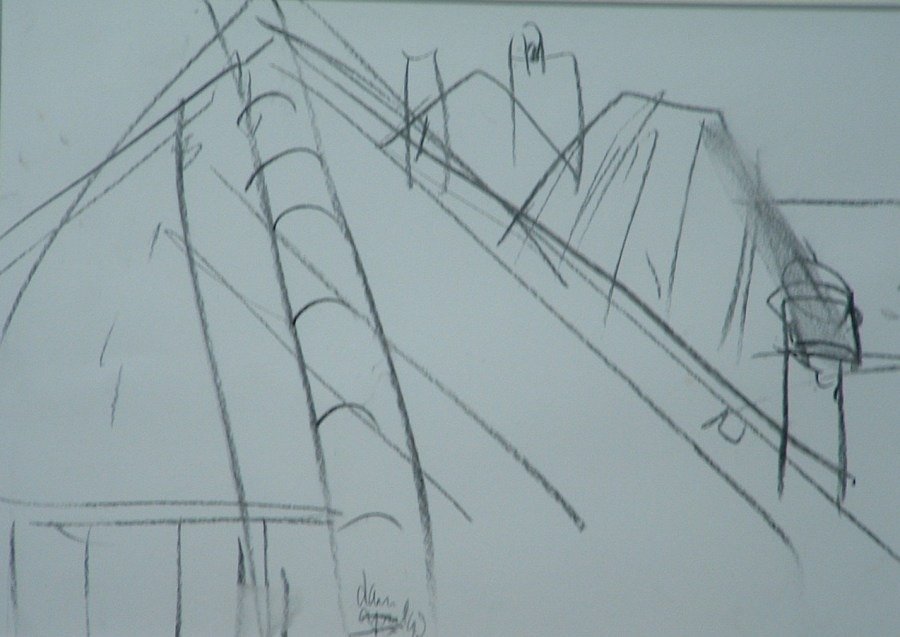
No. 17
Stolpen
Stolpen on De Woude, captured in pencil — the characteristic farmhouses of the island. The pyramid-shaped roofs of the stolp farmhouses are built up with quick, repeated lines, the drawing passing over the same contours several times until the shape settles. Details such as chimneys and roof windows are sketched in with a few short strokes. It is a direct, unpolished drawing — not a finished study, but a quick notation of a shape that is, for Henk van Dam, inseparable from the island.
€ 125
Ask about this work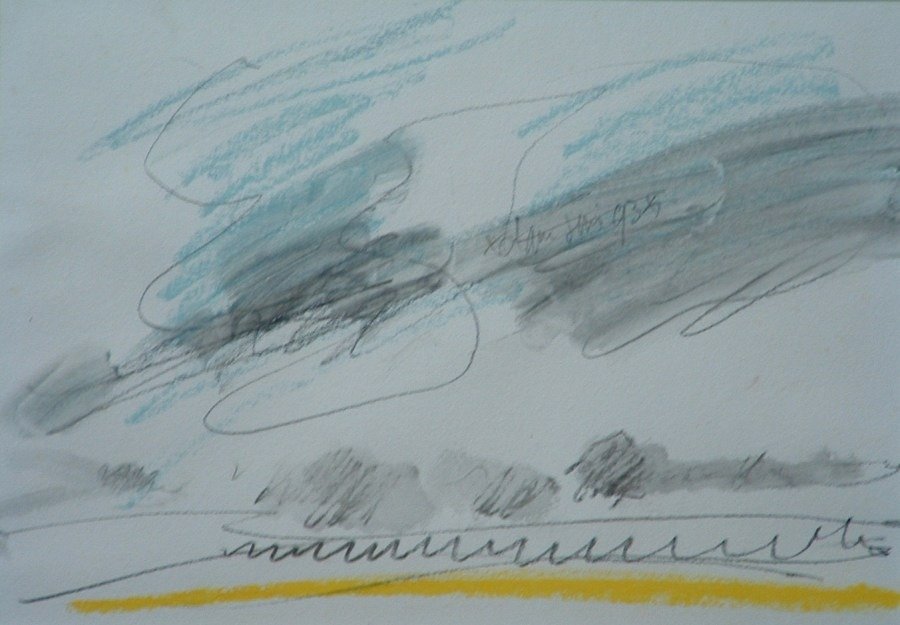
No. 18
Untitled — Island (18×24cm)
A pencil study of the island, sober and directly rendered. A broad sky of grey and pale blue chalk takes up most of the paper, with a thin drawn horizon of trees and reeds below. At the bottom a single stroke of yellow chalk closes off the composition — a small, warm accent against the otherwise cool, restrained tone of the rest of the sheet. The drawing carries the calm of the polder landscape without forcing a single detail.
€ 175
Ask about this work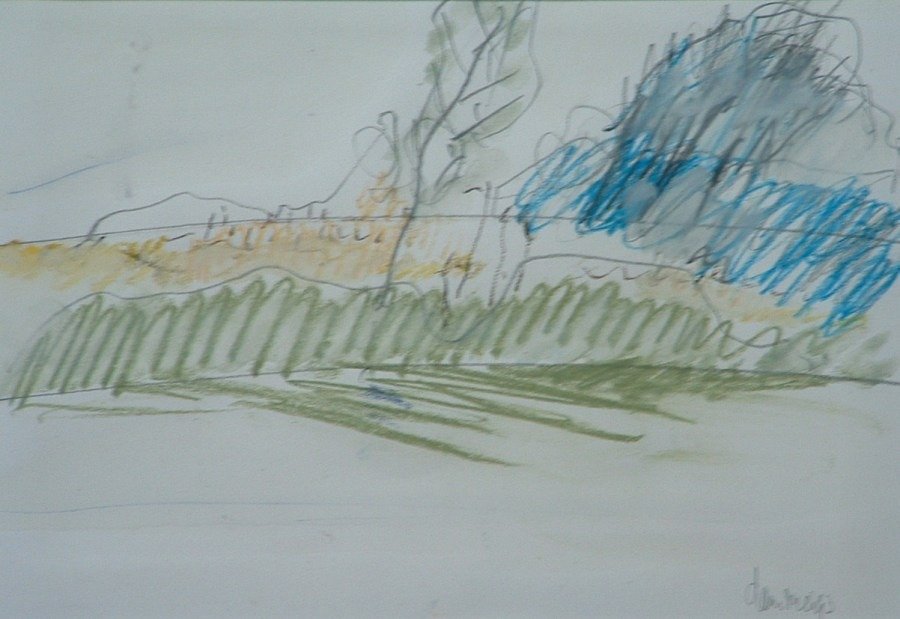
No. 19
Het Dampie
Het Dampie, a familiar spot on De Woude, drawn in pencil. A row of trees and shrubs stands out against a pale horizon, with a single tree picked out in bright blue pencil — a strange, almost electric note in an otherwise soft, green-grey drawing. Below, the shrubs cast long, rhythmically hatched shadows across the water. It is a drawing that stays close to observation, with just enough colour to give the spot its own mood.
€ 175
Ask about this work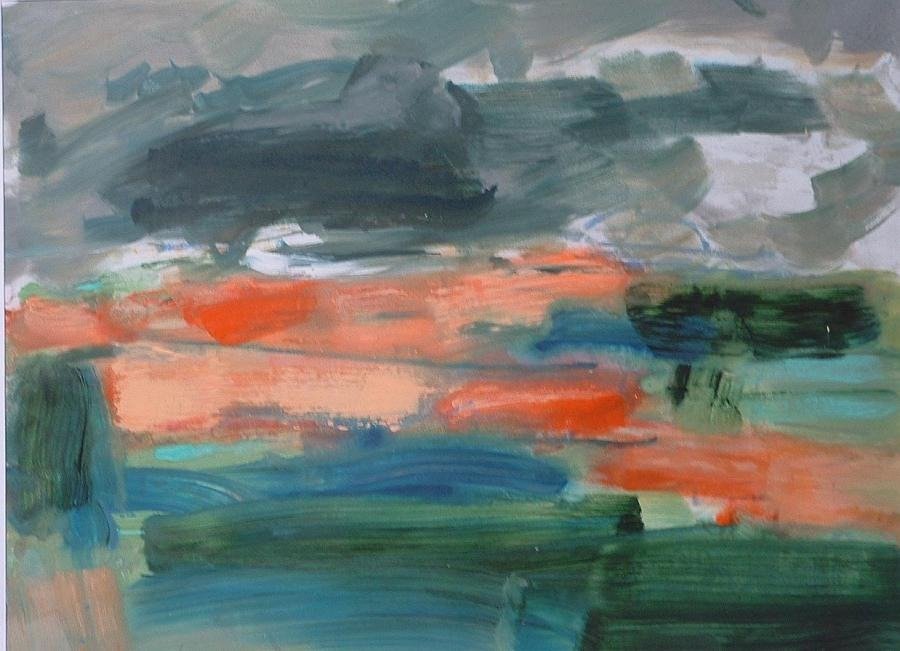
No. 20
Summer
Summer on the island: flowering sorrel in gouache, airy and light in colour. The canvas is built from broad horizontal bands: a grey, clouded sky at the top, a warm peach and orange tone in the middle evoking the sorrel in bloom, and a cooler blue-green band below for the water or grass. The paint is applied wet-in-wet, letting the colours bleed into each other at the edges. The result is less a landscape than a mood of colour — the sensation of a summer's day, without fixing a single recognisable detail.
€ 275
Ask about this work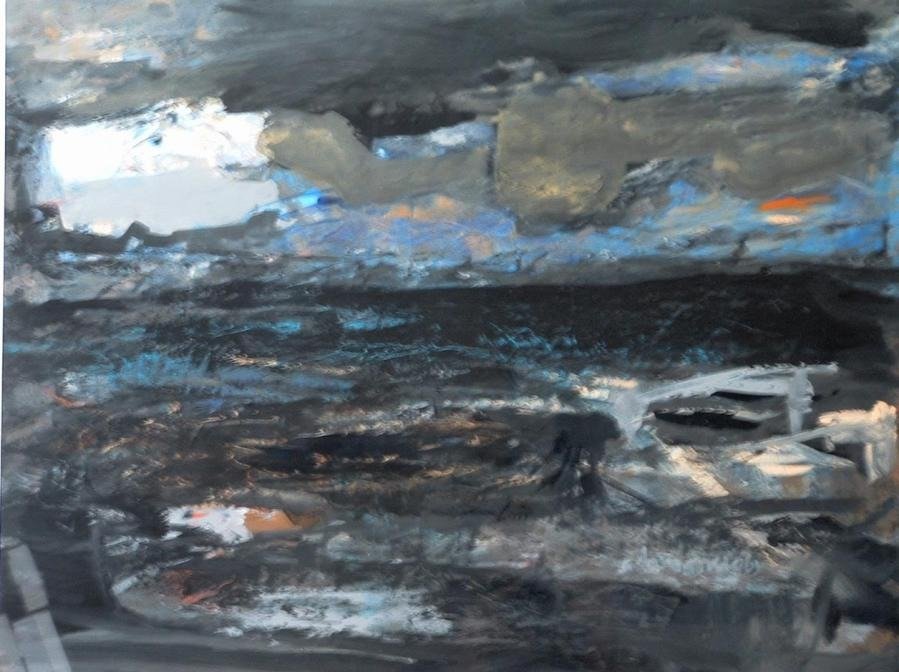
No. 21
Autumn storm
An autumn storm over the polder — the turbulent side of the season in gouache. A heavy, grey-blue cloud sky presses down on the land, thin electric lines of blue light flashing across it. At the bottom, almost drowned in the darkness, the faint shape of a small boat can be made out. Where the summer and winter canvases in the same series are airy and light, this is by far the darkest and most threatening — the season not as a backdrop, but as an unruly force.
€ 275
Ask about this work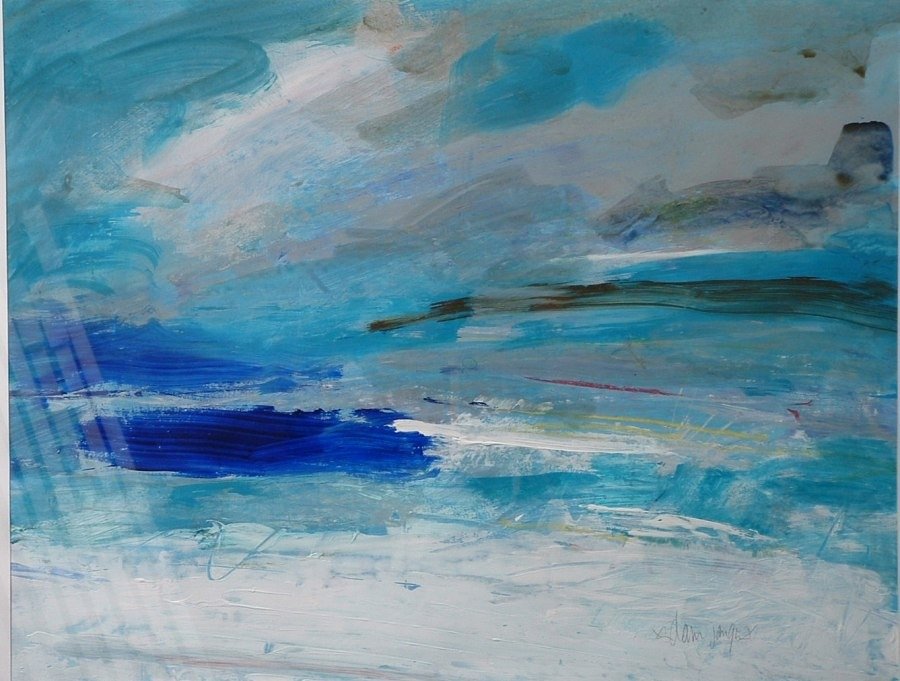
No. 22
Winter
Winter on De Woude, part of a series of four seasons in gouache. The whole canvas is immersed in a cool, clear turquoise and pale blue, with a single dark stroke of navy marking the far shore. At the bottom, the white of the paper itself becomes part of the composition — snow or ice, barely painted. It is the lightest and most transparent of the four season canvases, in which the cold is felt above all through what is absent: colour, weight, movement.
€ 275
Ask about this work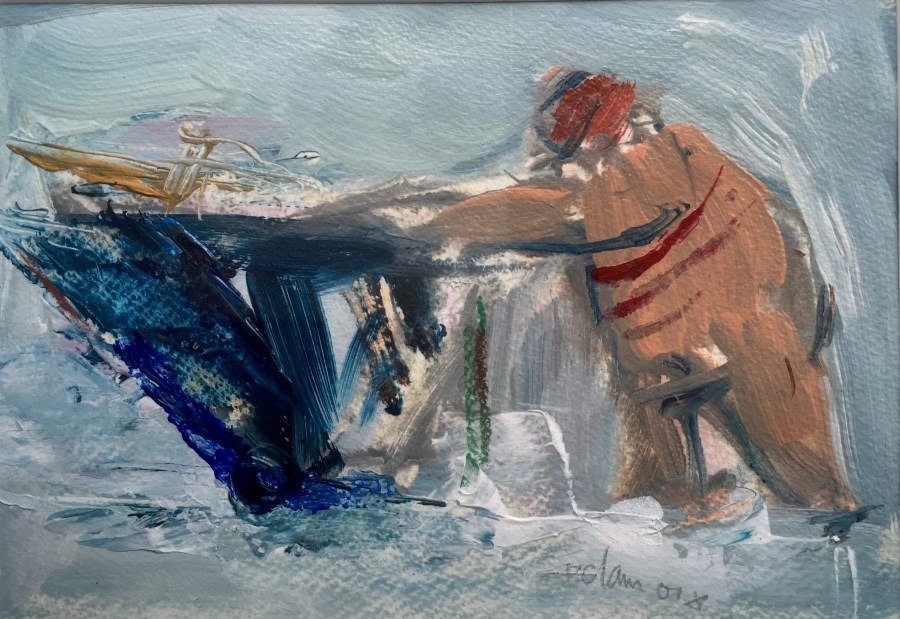
No. 23
Untitled — On the island (18×24cm)
An impression of island life, in gouache on paper. On the left stands a dense row of yellow and green vertical strokes — reeds or grass against the light — while on the right a dark, navy-blue shape rises that reads almost as a figure, wrapped in shadow. The two halves of the canvas stand in strong opposition: light and bright against dark and closed. It is one of the more enigmatic impressions in the series, evoking mood more than narrative.
€ 175
Ask about this work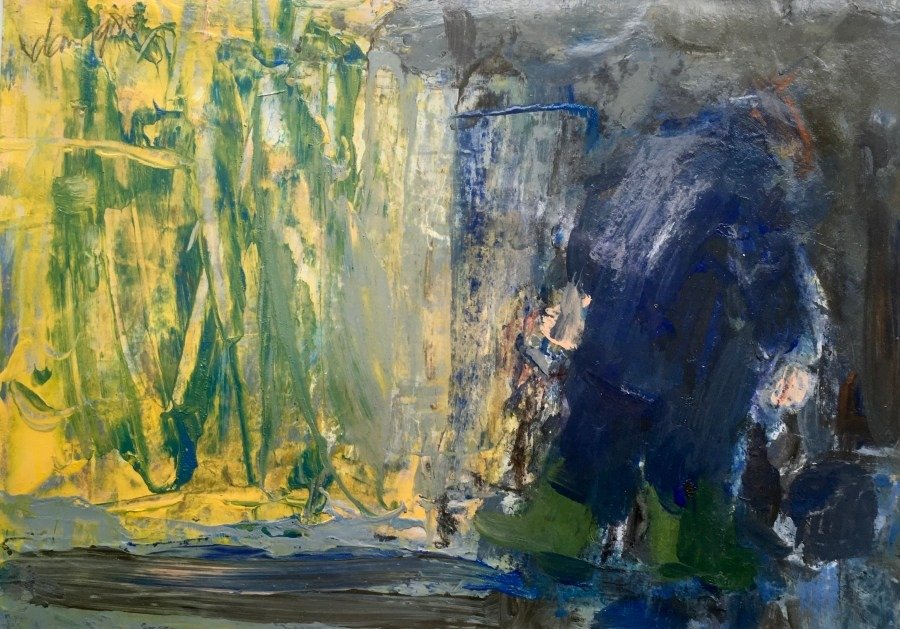
No. 24
Untitled — On the island (Gouache on paper)
Another impression of island life, quietly rendered. It is a sober, almost note-like sheet — not intended as a finished composition, but as a quick record of a familiar figure on the island.
€ 175
Ask about this work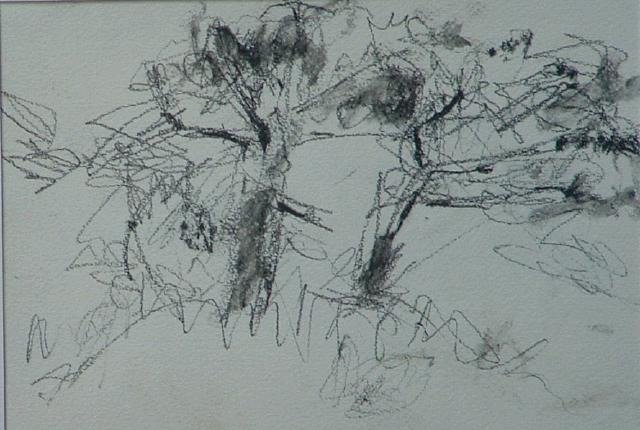
No. 25
Umbrella pines
Two umbrella pines leaning on a hill, dynamically rendered in pencil, with the brisk wind almost tangible through the branches and the wispy grass.
€ 125
Ask about this work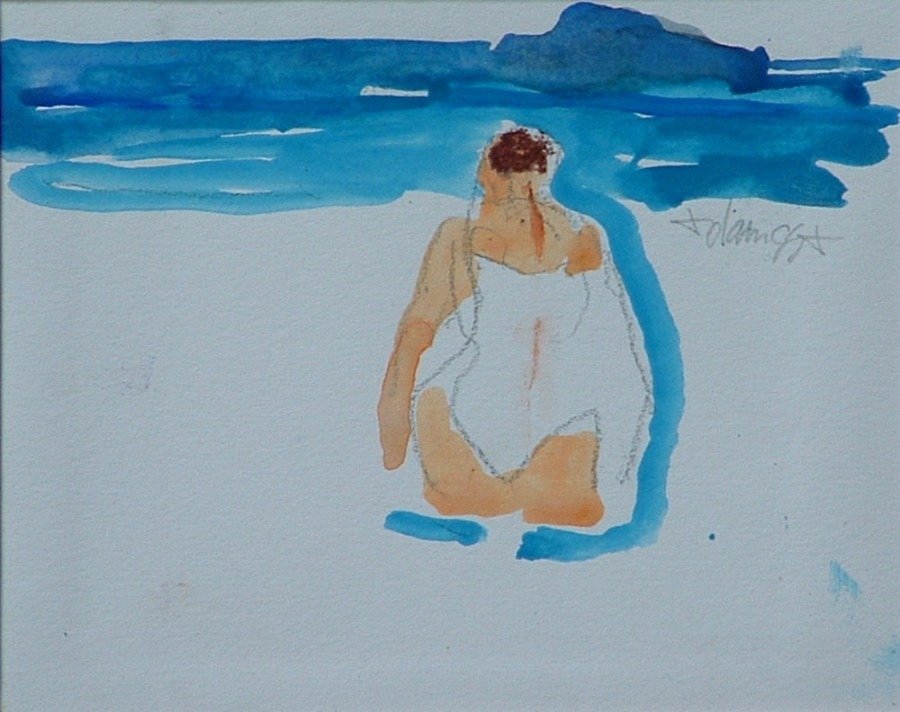
No. 26
Bather
A bather, captured in a fleeting gouache study. The figure walks into the water in a white bathing suit, with only the shoulders and reddish hair left free of colour. Behind her a broad band of bright blue water stretches to a dark rock formation on the horizon. The watercolour is applied thin and transparent, with pencil lines still visible through the paint — a moment captured before it disappeared again.
€ 125
Ask about this work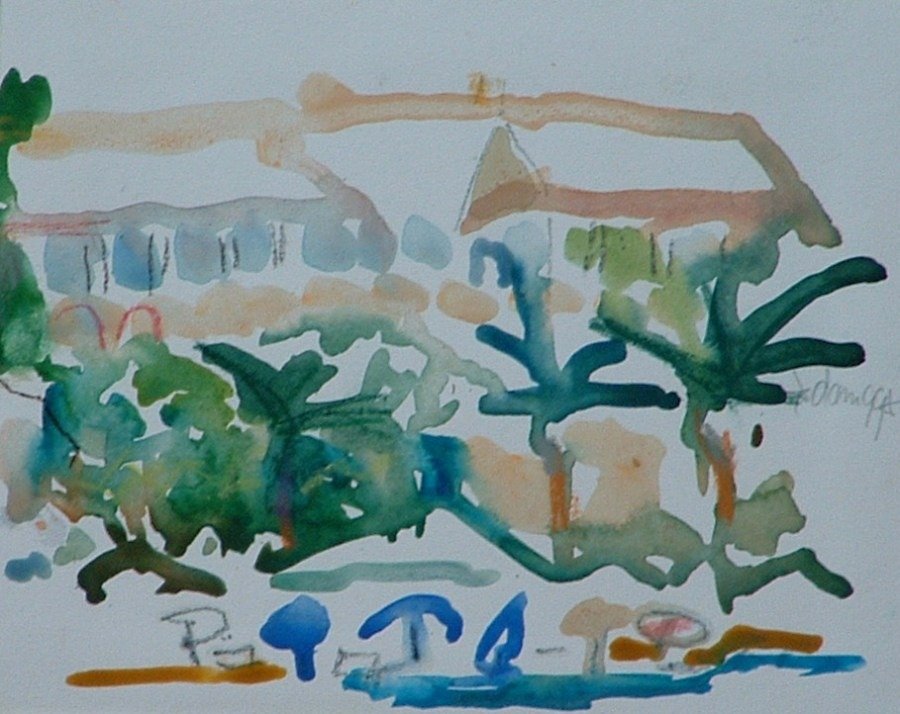
No. 27
At Sonja's, where we always swam, but never stayed the night
A memory of Sonja's, where they always went swimming, but never stayed the night. Behind a dense row of trees and shrubs in varying shades of green, the roofs and façades of a house loom faintly, in soft ochre and pink washes. At the bottom a few loose, almost childlike figures and animals are sketched in blue — a fleeting note within the larger memory. It is one of the few works in which Henk van Dam carries a personal anecdote directly into the title.
€ 125
Ask about this work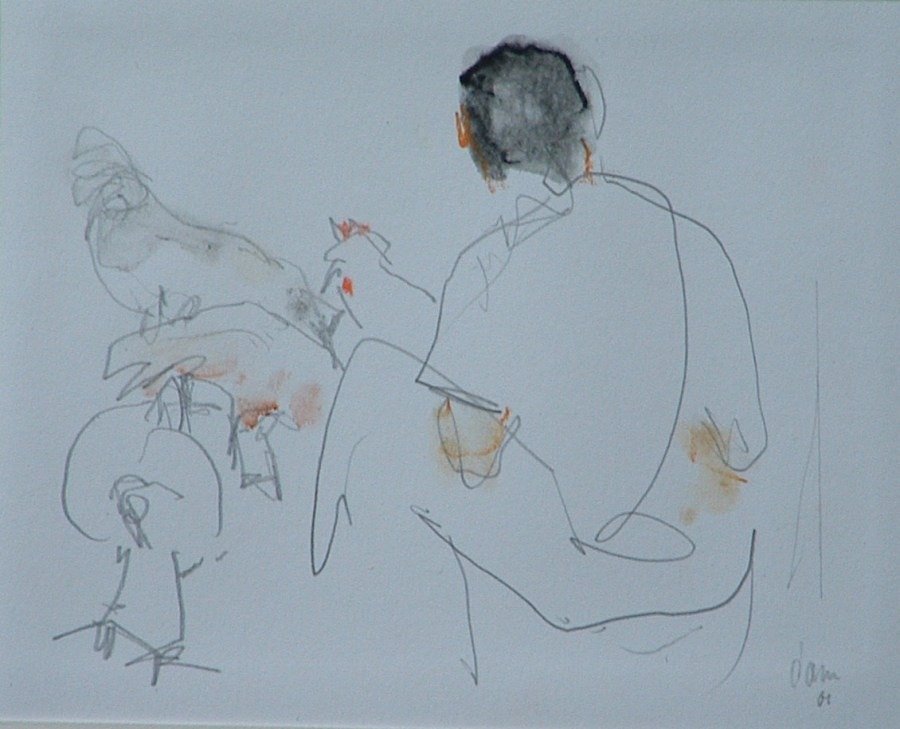
No. 28
Goods at the market
Goods at the market, an impression from one of his travels. With loose, quick pencil lines a few chickens and a crouching figure are sketched, with small orange-red touches giving just enough colour to bring the scene to life. The drawing remains deliberately unfinished: lines cross one another, some shapes are redrawn several times. It is a typical travel sketch — quickly observed, with no time for more than the essence of the movement.
€ 125
Ask about this work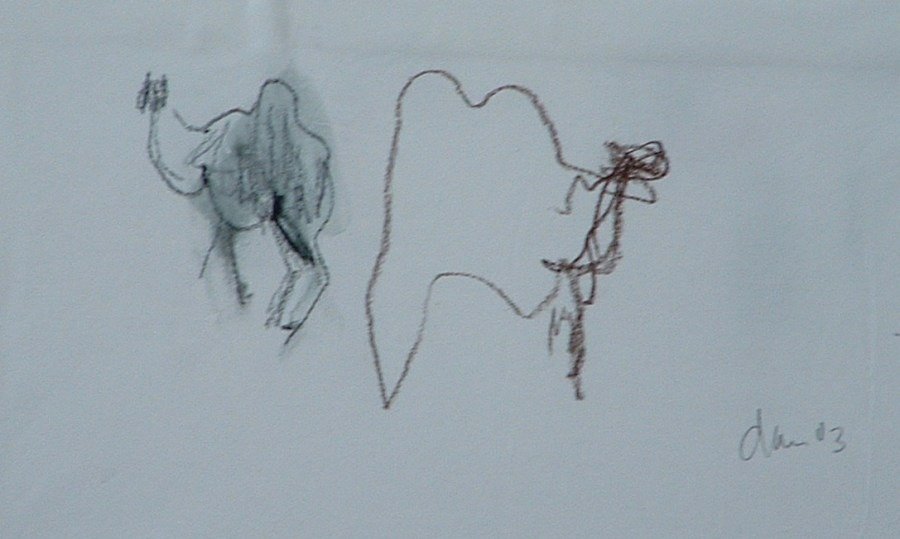
No. 29
Camel and dromedary
Camel and dromedary, observed at a market or in a port town. On the left a dromedary is firmly hatched in pencil, its high hump and legs set down in a few confident lines. Beside it, a second animal is sketched much more loosely — a single contour line with a tangle of reddish-brown scribbles where the head should be. The contrast between the two drawing styles within a single sheet shows how Henk van Dam works while travelling: first looking and recording, then sketching faster as the moment passes.
€ 125
Ask about this work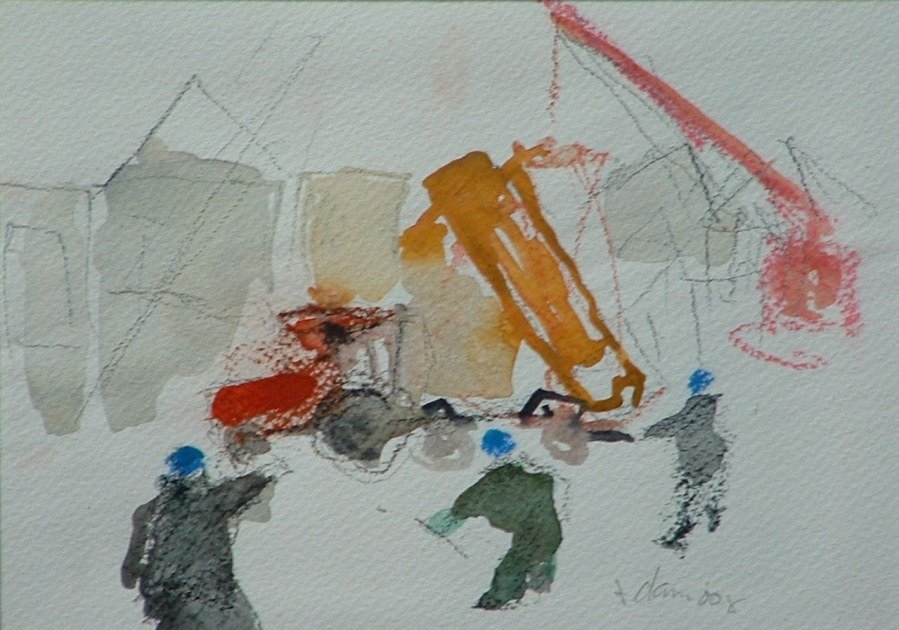
No. 30
Untitled — Impressions (12×18cm)
A watercolour impression from along the way, swiftly and directly captured. An orange-yellow excavator or crane with a red hook dominates the centre of the sheet, surrounded by a few small figures in blue helmets at work. The houses in the background are barely more than a pencil line, while the machine itself is the only place where colour is truly applied. It is an impression of a port town or market, seen in passing.
€ 125
Ask about this work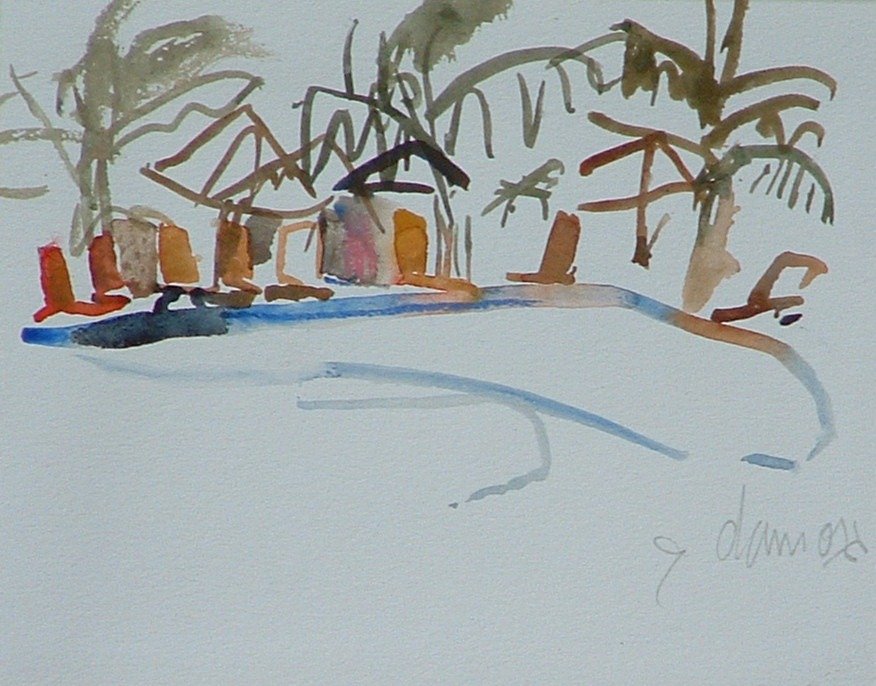
No. 31
Untitled — Impressions (12×18cm)
An impression in gouache, part of the series of travel impressions. A row of small houses with pointed roofs in ochre, red and orange stands at the edge of a broad, pale blue stretch of water, with dense green shrubbery as a backdrop. The architecture is summarised in a few quick lines, without going into detail. It is a typical example of how Henk van Dam works while travelling: a village or hamlet passing by, reduced within a few minutes to a composition of coloured marks.
€ 125
Ask about this work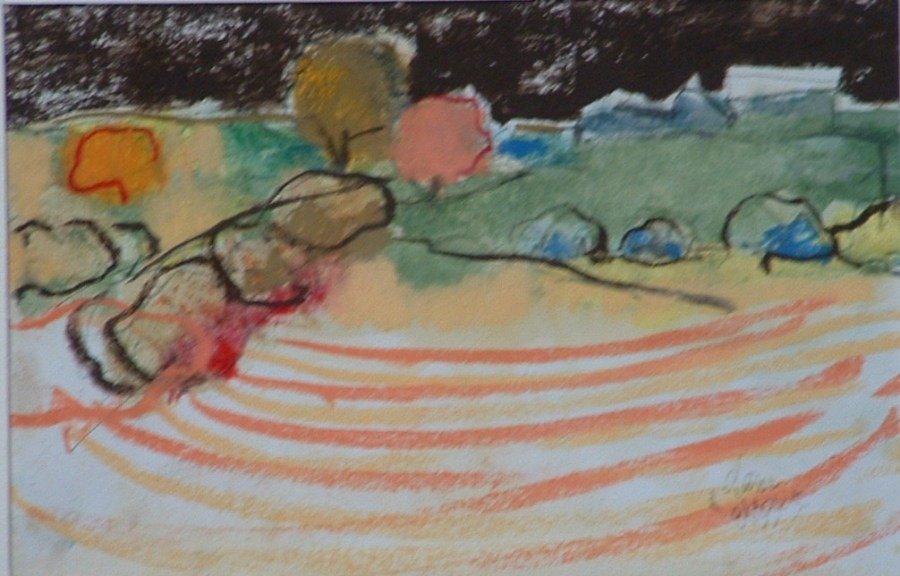
No. 32
Landscape
A landscape in gouache and chalk, built up in layers on paper. A dark, almost black row of trees forms the top edge of the sheet, with a few loose little trees in orange and pink below, standing as accents in the green field. At the bottom the composition opens into broad, undulating strokes of salmon pink and orange — water or light sliding across the land. The combination of chalk and gouache gives the sheet a grainy, tactile texture that reaches deeper than an ordinary watercolour.
€ 225
Ask about this work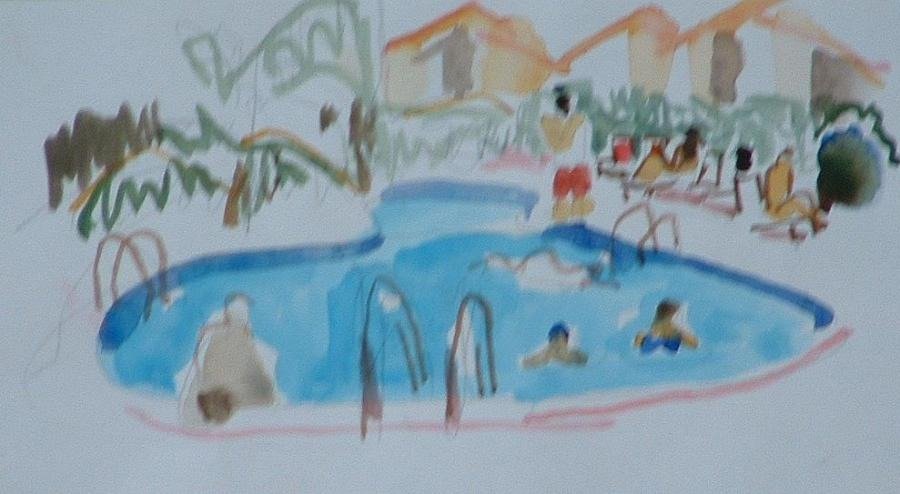
No. 33
Holiday paradise
Holiday paradise — an airy impression of a sunny destination. A swimming pool in bright blue fills the centre of the sheet, with a few holidaymakers sketched swimming or sitting in and around its edge. In the background stand buildings with orange-yellow roofs, half hidden behind loosely drawn greenery. The title is meant lightly ironically: this is not an idyllic, fully worked holiday scene, but a quick, almost wry note on the cliché of the sunny destination.
€ 125
Ask about this work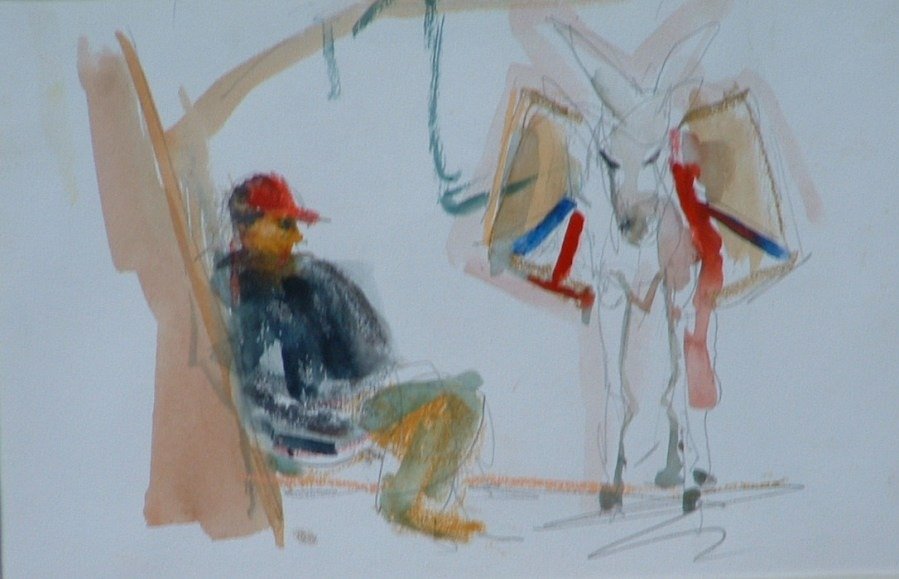
No. 34
Trader
A trader, observed at the market. The man sits relaxed against a wooden frame, wearing a red cap, legs crossed. Beside him a donkey waits patiently, loaded with saddlebags in bright red and blue that catch the eye amid the otherwise watery, pale watercolour tones. It is a quiet moment within a busy market scene — the trader not at work, but caught for a moment in the pause.
€ 125
Ask about this work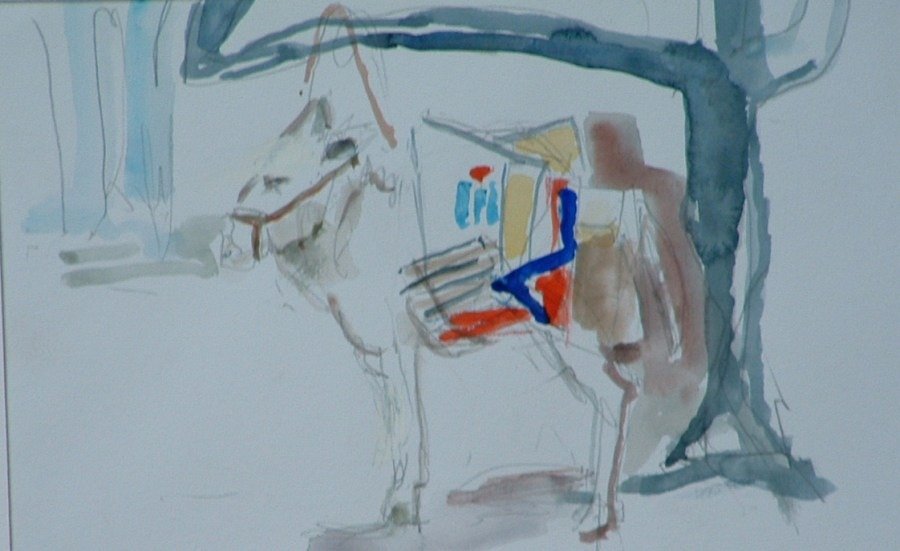
No. 35
The trader has stepped away
The trader has stepped away — an empty stall, captured in gouache. All that remains here is the donkey, with its loaded saddlebags in red, blue and yellow, standing beneath a dark, solidly painted tree. The human figure is absent: no trader, no customer, only the animal and its load. It is the mirror image of the other market sketch — not the trader himself, but the sign of his absence.
€ 125
Ask about this work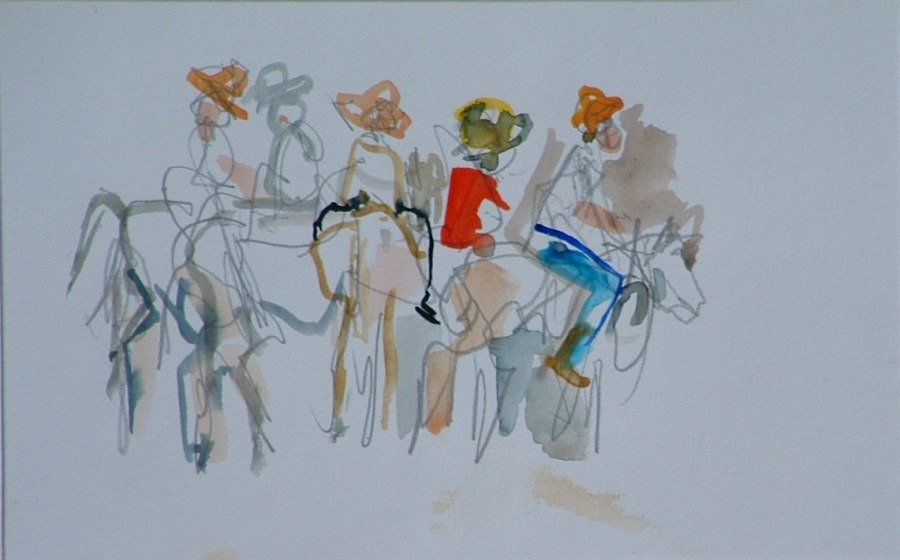
No. 36
Rodeo
Rodeo, an impression of movement and action in watercolour. A group of riders in brightly coloured hats — yellow, orange, red — presses together on the sheet, the horses only just recognisable in the quick, overlapping lines. Colour is used sparingly and pointedly: a red sleeve here, a blue trouser leg there, against an otherwise restrained, watery ground. The pace of the drawing itself seems to mimic the energy of the event.
€ 125
Ask about this work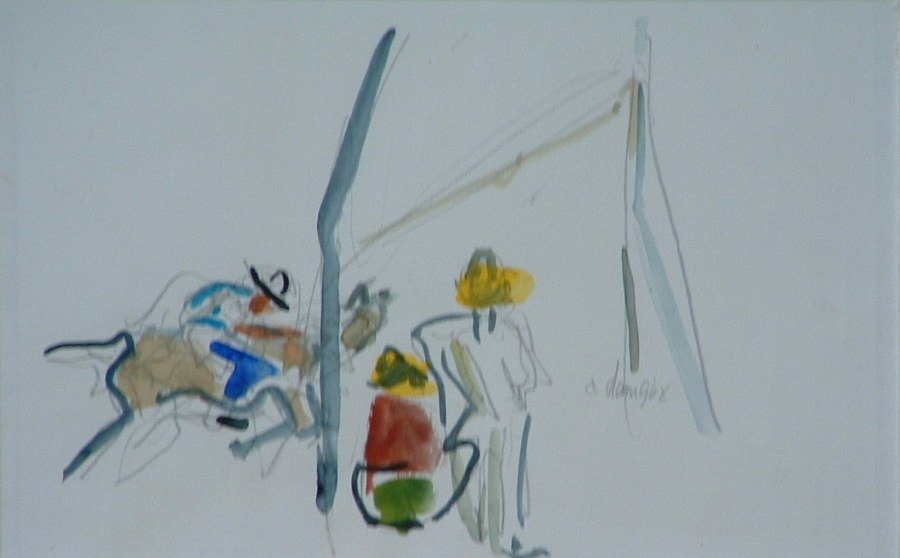
No. 37
Untitled — Impressions (12×18cm)
Another untitled gouache impression from the same series of travel impressions. On the left a rider is sketched on a lying or stumbling horse, with blue and red touches of clothing; on the right stand two figures in yellow hats, perhaps onlookers, beside a tall pole or tent post. The sheet is largely left empty — pencil lines that have only just begun, colour tapped in sparingly over the top. It feels like a moment caught between two events, more a note than a finished scene.
€ 125
Ask about this work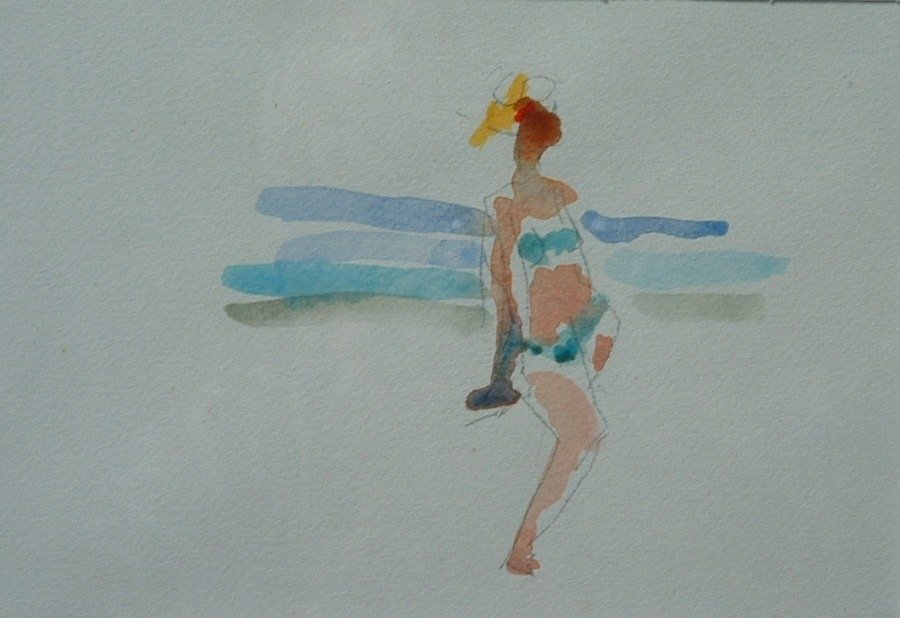
No. 38
Lady
A lady, captured in watercolour — glimpsed in passing, quietly rendered. She walks away from the viewer, her reddish hair loose, in a bikini. Behind her lie broad, horizontal bands of blue — sea or sky, left unspecified — that make the figure seem almost to float in an abstract space. The pencil lines beneath the paint remain visible, giving the drawing something provisional, something still in motion.
€ 125
Ask about this work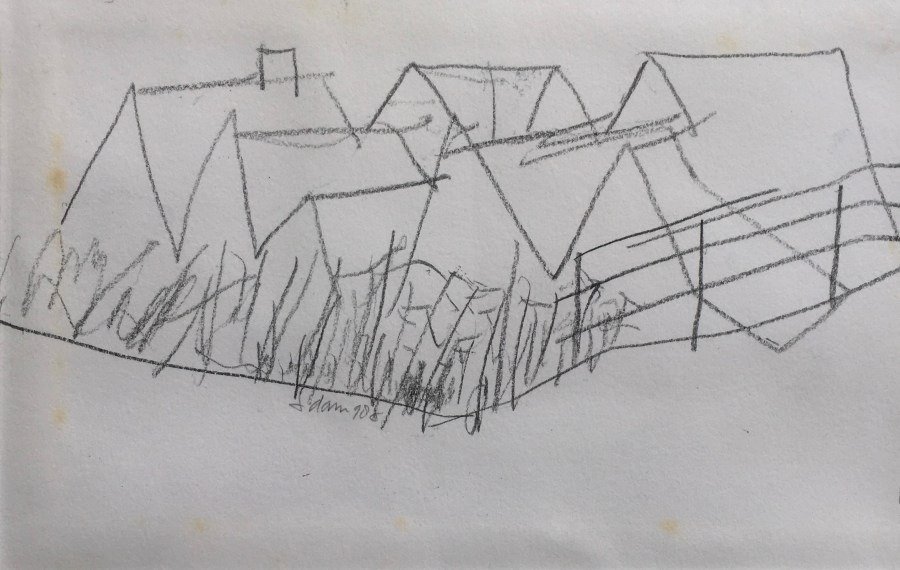
No. 39
Driehuizen
Driehuizen, a pencil study of a familiar spot. Three pointed roofs stand side by side, with a small chimney above the left-hand house, while in front a dense border of reeds or tall grass is filled in with short, upward strokes. A fence or path cuts through the composition on the right. The drawing is built up with visible repetition — lines gone over several times — which gives the place a certain solidity, even though the execution stays sketch-like.
€ 125
Ask about this work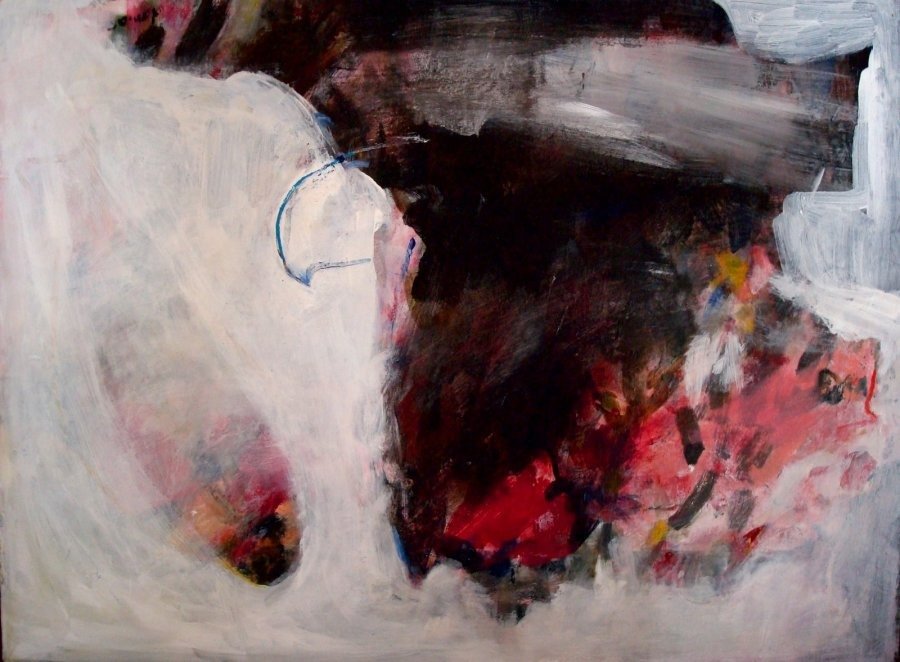
No. 40
White-tailed eagle
A white-tailed eagle over the water — one of the few animal studies in his work. The bird is barely recognisable as an animal: a large, white shape with a thin blue contour line floats against a dark, almost black background shot through with deep red. It is less a portrait of the eagle than a sensation of something large and still standing out against a threatening sky or expanse of water. As in the Markervaart canvases, Henk van Dam is not concerned with the exact silhouette, but with the force of the contrast.
€ 525
Ask about this work